
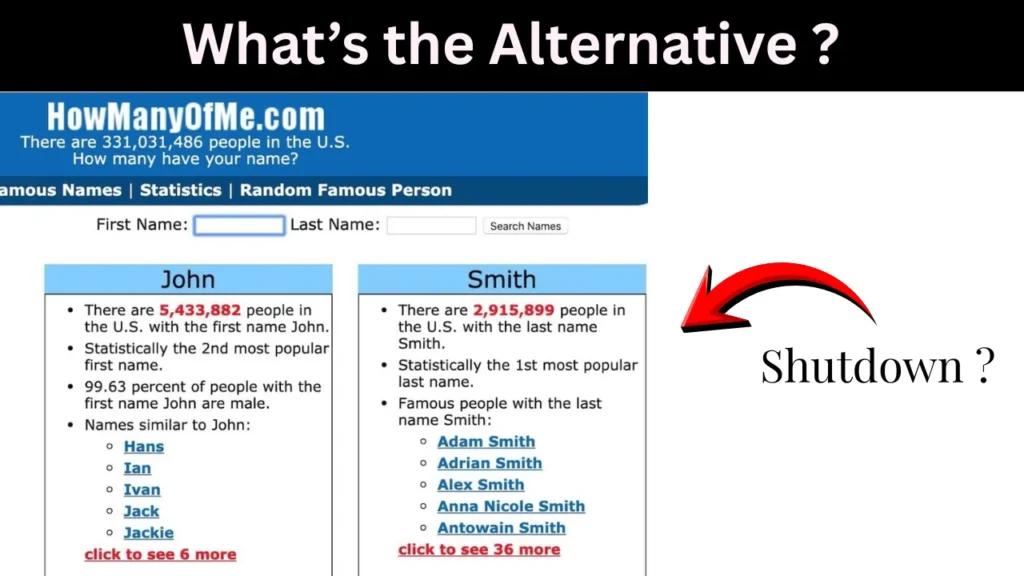
If you’ve searched for HowManyOfMe.com recently expecting to type in your name and see how many other Americans share it, you’ve probably run into a dead end. That’s not a temporary outage. The original site is gone, and it isn’t coming back.
Here’s what actually happened, based on what’s publicly documented, and a straightforward alternative that works today.
What HowManyOfMe.com Actually Was
HowManyOfMe.com launched in 2006, built by Auron Technologies LLC. The concept was disarmingly simple: type in a first name, a last name, or both, and the site would estimate how many people in the United States shared that exact name, using real government name-frequency data rather than guesswork.
For over a decade it was a quiet, useful little tool, the kind of site people would casually mention to friends or use in a classroom to talk about statistics. Then, in August 2019, it had a genuine viral moment. A Reddit post using the site to look up the name “Dick Dick” took off on r/me_irl, and a wave of follow-up memes pairing HowManyOfMe.com results with reaction images spread from there, one post alone gathered more than 69,000 upvotes. For a brief window, checking your name’s rarity on HowManyOfMe.com was a genuine internet trend.
When and Why It Closed
Multiple independent sources, including outage-tracking sites and tech blogs, place the closure sometime in 2023. By late 2023 and into early 2024, several “alternatives to HowManyOfMe” articles had already been published, confirming the site was gone rather than just experiencing downtime. As of today, there’s still no indication it’s returning; the domain has sat inaccessible for an extended stretch, well past what you’d expect from routine maintenance.
The exact reason for the shutdown has never been officially confirmed. The most repeated explanation among people who tracked the site over the years is some combination of declining traffic, the ongoing cost of maintaining it, and changes in how the underlying government data was made available, though this is inference from outside observers, not a statement from Auron Technologies itself. One blogger who’d written about the site for years also noted an unverified rumor that a surge in traffic (reportedly after a mention on a TV show) may have overwhelmed the server at some point, but that’s explicitly flagged as a rumor, not a confirmed cause, in the source itself.
If you want to see what the original looked like, the Internet Archive’s Wayback Machine has crawled snapshots of most public websites for over two decades and is worth searching for howmanyofme.com directly if you’re curious about its history.
What People Actually Used It For
Reading through years of forum posts and blog comments about the site, the appeal was always the same: it turned an abstract question, “is my name common or rare?”, into a specific, personal number. People used it to:
- Check how many people shared their exact first and last name combination
- Settle casual arguments about whether a name was “unique”
- Use it as a lightweight, fun statistics example in classrooms
- Look up names of public figures or fictional characters out of curiosity, which is exactly what fueled its 2019 meme moment
None of that curiosity went away when the site did. It just lost its home.
A Real Alternative, Built on the Same Kind of Data
How Many of Me was built to answer the same question, how many people share a given name, using the same category of authoritative government sources the original relied on:
- Social Security Administration birth records going back to 1880, for first-name frequency and trends over time
- US Census Bureau surname data for last-name frequency, sourced from the government’s own decennial surname files
- A living-population estimate that adjusts raw historical birth counts for the fact that people born in, say, 1920 are far less likely to still be alive today than people born in 1995
You can search a name here and see, in one view: the estimated number of living Americans with that name, how rare or common it is expressed as both a percentile and a “1 in X people” figure, the gender split, which generation carries the name most, how its popularity has moved decade by decade since 1880, which states have the highest concentration of it, and the name’s meaning and linguistic origin.
For last names specifically, results come from the real 2020 Census Bureau surname file, not modeled from birth records the way first names are, since the Census Bureau and the Social Security Administration measure genuinely different things and the site is built to keep that distinction honest rather than blur it. You can read the full breakdown of how each number is calculated on the methodology page.
Trying It Yourself
Head to the How Many of Me homepage, type in a first name, a last name, or both, and the results load in a few seconds directly in your browser. No account, no email address, and nothing you type is stored, the same no-friction experience the original site was known for, just built on top of current, actively maintained infrastructure.
All figures referenced are statistical estimates derived from public government datasets, not exact real-time counts. See the methodology page for the full explanation of how each estimate is calculated.