
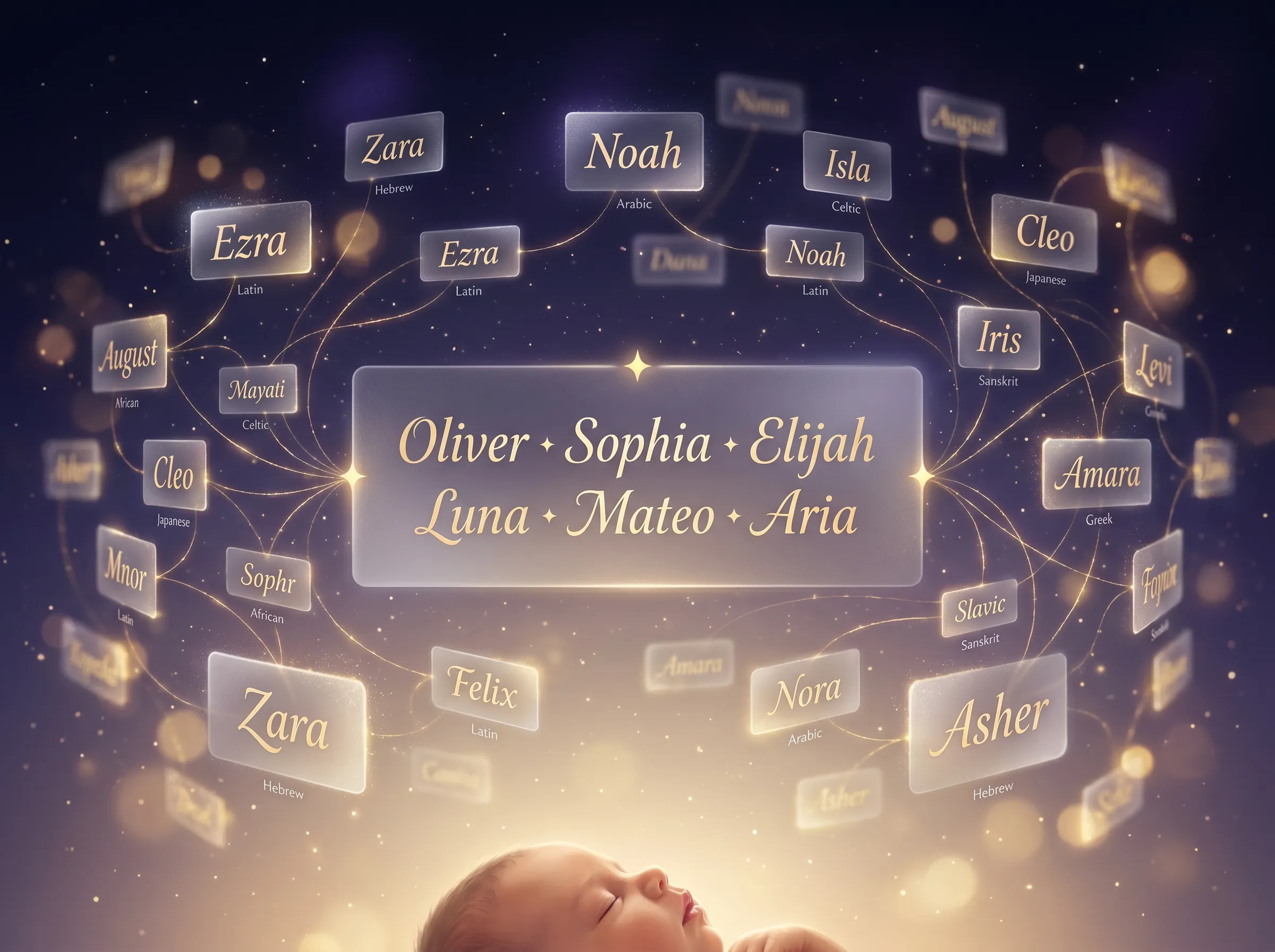
Find a Name Your Kid Will Actually Thank You For
Picking a baby name feels impossible until you land on the right one, and then it's obvious. You'll spend weeks second-guessing lists, texting ideas back and forth, and hearing "I know someone named that" at least three times. That's exactly why this baby name generator exists.
It's a free baby name generator that works in a bunch of ways, not just one. Use it as a baby name generator with last name to find first names that flow with your surname, as a baby name generator using sibling names to keep things consistent with the kids you already have, or as a baby name combiner using parents names to blend mom and dad's names into something real. No filters in mind? Set everything to "Any" and let it run as a random baby name generator instead.
However you use it, you get eight real options with full pronunciations, meanings, and rarity scores every time. Narrow or broad, specific or random, it handles all of it.
Quick numbers before you dive in. The Social Security Administration registers around 3.6 million births in the US every year, pulling from a pool of over 17,000 distinct names. Olivia's held the top girl spot for six years straight, and Liam and Noah have been trading the top boy spot since 2013.
The top 10 names make up roughly 8% of all births, so picking something in that range means your kid shares a classroom with a few others who have the same name. Outside the top 500 though, there are still thousands of names with real history and meaning behind them. You've got plenty of room to work with.
What the Tool Actually Shows You
Most name databases hand you an alphabetical list with a one-word meaning and call it done. This one actually matches names to your situation.
Set your filters: gender, cultural origin, starting letter, name length, a meaning theme like strength or nature, and a style vibe. The AI generates eight results. Each card shows the full etymology (not just "means happy"), a phonetic pronunciation guide, three personality traits, a numerology number, and a rarity rating pulled from SSA birth records.
The last name and sibling fields are where this baby name generator with last name support gets genuinely more useful than scrolling a list. Type your surname and results shift toward names that flow with it phonetically.
Enter your other kids' names and the suggestions adapt to match the style already in your family. You can also check any name you find here against the name frequency checker to see exactly how many Americans share it right now.
Smart Filtering
Gender, origin, last name compatibility, sibling style matching, starting letter, length, meaning, and vibe, all active at once.
Real Etymology
Every name includes where it came from, what it originally meant in its source language, and a short cultural history.
Name Combiner
Enter both parents' names and get results that carry something from both, not random suggestions, but phonetically linked picks.
Rarity Ratings
Common, Uncommon, Rare, or Very Rare. Know where a name sits in the population before you commit to it.
13+ Origins
Hebrew, Arabic, Japanese, African, Celtic, Sanskrit, and more. Every major naming tradition represented.
Pronunciation Guides
Every result shows you exactly how to say it, so there are no awkward surprises the first time you introduce your kid.
Why Your Last Name Changes Everything
This is the detail most parents figure out the hard way. You fall in love with a name, say the full thing out loud once, and immediately hear the problem. "Ryan Ryan." "Emma Hammer." It comes down to a few basic phonetic rules, and they're easy to apply once you know them.
When your last name ends in the same sound as your first name, things blur together. "Bella Patel" flows better than "Ella Patel" just because of how the L lands. Matching syllable counts can feel choppy too, so one shorter and one longer name usually sounds more natural.
A short surname like Chen or Park pairs well with a two or three syllable first name. A heavier surname like Abramowitz works better with something punchy, think Max, Leah, or Kai. And if your last name starts with a hard consonant, a softer-ending first name like Luna or Mia usually sounds cleaner.
The last name field in this baby name generator with last name feature runs that analysis automatically. Type your surname and results weight toward names that actually sound good together with yours, not just names that sound good alone. The same logic kicks in with the baby name combiner using parents names tool too, so the cultural origin you pick can match both sides of the family.
Picking a Name When You Already Have Kids
Second and third-time parents have a harder job than they expect. The new name has to work on its own, but it also has to sit comfortably next to the names you've already given. "Liam and Ava" sounds like a family. "Liam and Persephone" feels off, not because either name is bad, but because the styles pull in different directions.
Use the baby name generator using sibling names option and enter your existing kids' names. The tool looks at syllable counts, cultural origins, and overall sound. Classic names like Charlotte and James will pull suggestions toward that same register, while distinctive choices like Zephyr and Indigo shift things toward that energy instead.
The goal is a sibling set that sounds like it was chosen together, even with a six-year gap between kids. Just enter names separated by commas and let the generator handle the matching.
Names That Honor Both Families
There's a long tradition across nearly every culture of naming a child to carry something from both parents. The tricky part is doing it without ending up with something that sounds made up, like "Jascott" when one parent is James and the other is Scott. This baby name combiner using parents names approaches it differently.
Enter both parents' first names and the tool finds genuine names, not blended-up words, that connect to both phonetically or culturally. If one parent is Sarah and the other is Marcus, you might get Mara (draws from both), Samara (shares sounds with Sarah while touching the Semitic roots Marcus also connects to), or Carius (an actual Latin name, not a mashup). Each result comes with a note explaining the connection, so the reasoning is clear. It's a meaningful way to land on a name that carries real family history instead of something random.
Explore by Origin
Every culture has names that have lasted for a reason. Click any origin below to generate names from that tradition right now.
What's Trending in 2026, and Why
Name trends move in roughly 30-year cycles, long enough that grandparent names feel fresh again. Three currents are dominant right now, and each one has a clear reason behind it.
Short names are everywhere. Kai, Zoe, Eli, Isla, Leo, Ava. One or two syllables, easy to say in any language, basically impossible to mispronounce. Part of this is practical (they travel internationally without friction), and part of it's a pushback against the heavily embellished naming style that peaked in the 1990s and early 2000s.
Old-fashioned names have genuinely returned. Theodore was a grandfather name for two decades, now it's top 10 in several states. Eleanor, Hazel, Walter, and Josephine are all climbing. These names carry history without feeling stuffy, and they hold up across a whole lifetime in a way trendy names sometimes don't.
Nature and place names keep rising. River, Sage, Rowan, Aurora, Ember, and Forrest are all gaining ground. Arabic and Hebrew names are also being picked well outside their origin communities, Zara, Layla, Ibrahim, and Ayaan all score high on sound and meaning. For deeper trend data and decade-by-decade shifts, check the name statistics tool on this site, which covers 140 years of SSA records.
Trending Boy Names in 2026
Trending Girl Names in 2026
Getting the Most From Your Search
Start with what actually matters to you, sound or meaning. If you want the name to mean something specific (strength, light, nature), hit the meaning filter first and keep everything else flexible.
Got a surname that's tricky to pair with, hyphenated, very long, or ending awkwardly? Start with the last name field and let the phonetic analysis do the work.
Already have kids? Always fill in the sibling field. It genuinely changes the results and stops you from shortlisting names that feel jarring next to the ones you already picked. For the name combiner, experiment a bit. Try first names, then middle names if those carry more cultural weight. Some of the best results come from combos you wouldn't have predicted.
And if you're totally stuck, set every filter to "Any," leave the optional fields empty, and just generate. Sometimes seeing eight random names from completely different traditions is enough to shake loose what you actually want. You can also check any name's exact frequency and historical popularity in the name checker on this site, which uses 140+ years of birth records.
Frequently Asked Questions
Will it suggest names that sound good with my last name?
Yes. Enter your surname in the Last Name field and the generator adjusts results to favor names that flow naturally with it, based on syllable count and ending sounds. A one-syllable last name like Chen pairs differently than a four-syllable name like Kowalczyk, and the tool accounts for that automatically.
How do I find names that fit with my other children's names?
Enter your existing children's names in the Sibling Names field, separated by commas. Results shift to match the style, syllable count, and cultural feel of names you already have, so the new addition fits the family rather than clashing with it.
How does the name combiner work exactly?
Enter both parents' names in the Baby Name Combiner section. The tool finds real names, not invented words, that share phonetic elements, linguistic roots, or cultural heritage from both inputs. Each result includes a note explaining the specific connection, so you understand why the link exists rather than just seeing a random suggestion.
Can I filter by cultural origin or name meaning?
Yes. The tool covers 13 cultural origins including Hebrew, Arabic, Latin, Greek, Irish/Celtic, Scandinavian, French, Spanish, Italian, Sanskrit, Japanese, and African. You can also filter by meaning theme: strength, light, nature, wisdom, love, hope, royalty, or grace.
Is this completely free to use?
Completely free, with no account or email required. Generate as many sets of names as you want. Nothing you enter is stored or tracked.
How rare or popular is each name?
Every name card shows a rarity rating: Common, Uncommon, Rare, or Very Rare, based on Social Security Administration birth records going back to 1880. For exact frequency data and decade-by-decade trend lines, the name statistics tool on this site looks up any name by its full historical record.
What information does each name card include?
Each result shows the name, phonetic pronunciation, gender, a poetic meaning summary, cultural origin, a two-sentence description covering etymology and why parents tend to choose it, three personality traits historically associated with the name, a numerology number, and a rarity rating.
Can I use this as a fully random name generator?
Yes. Set every filter to "Any," leave all optional fields blank, and hit Generate. You'll get eight names from across all origins and styles, useful when you want to break out of a naming rut and find options you wouldn't have thought to search for.
More Name Tools on This Site
This generator is one part of a broader set of name research tools here. Use them together for a complete picture before you make a final decision.