

When you hear someone’s name for the first time, your mind immediately starts forming a picture of them long before you ever meet. Most people assume these snap judgments come from memories or cultural bias, but something deeper is happening. The sound of a name alone can shape how someone is perceived.
This subtle phenomenon has a name, and it plays a surprisingly powerful role in how people react to you.
What Is the Bouba-Kiki Effect?
The Bouba-Kiki Effect is a psychological principle showing that our brains naturally connect certain speech sounds with visual shapes and personality traits. This is not random or learned behavior. It appears to be wired into how humans process sound and meaning.
The idea was first introduced in 1929 by psychologist Wolfgang Köhler, and later popularized by neuroscientists Vilayanur Ramachandran and Edward Hubbard.
The Classic Bouba-Kiki Experiment
In the original experiment, participants were shown two shapes:
- One smooth and rounded
- One sharp and spiky
They were told that one shape was called “Bouba” and the other “Kiki,” then asked to match the names to the shapes. Across different cultures, languages, and even among toddlers who could not read, the result was consistent.
Most people labeled the spiky shape as Kiki and the rounded shape as Bouba.
This happens because our brains naturally associate sharp sounds like K, T, and P with sharp visuals, and soft, rounded sounds like B, M, L, and O with smoother shapes.
What This Has to Do With Names
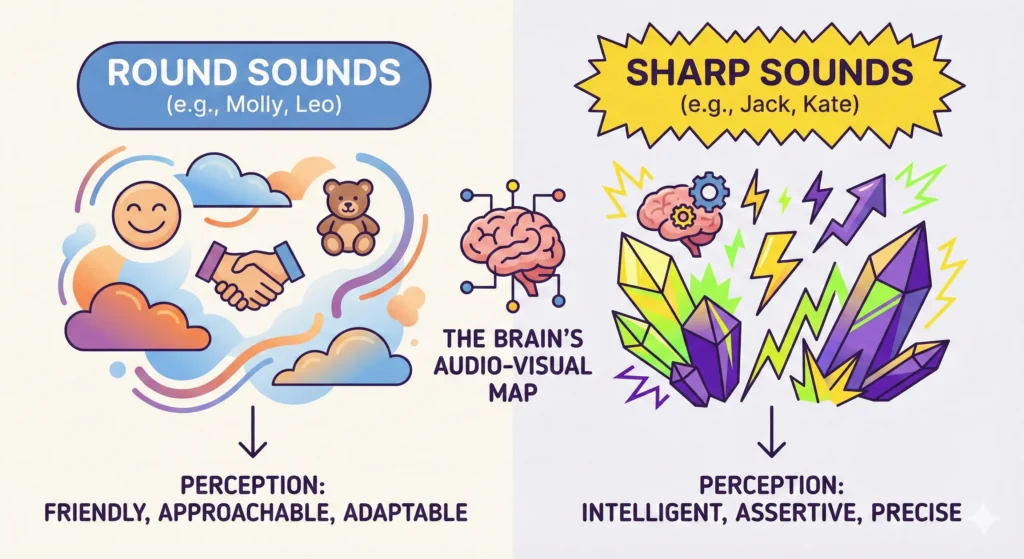
Names are built from sounds, and those sounds carry meaning. Psychologists believe the sound structure of a name influences how people perceive personality traits such as friendliness, intelligence, strength, and approachability, especially during first impressions.
That is why names like Bob and Kirk feel completely different, even if you know nothing else about the person.
Bouba Names: Soft, Warm, and Friendly
How They Sound
Bouba-style names use voiced consonants and open vowels that require the mouth to round when spoken.
Examples: Molly, Leo, Jonah, Luna, Bob, Owen
How They Are Perceived
People with these names are often seen as warm, easygoing, and approachable. They tend to give off a friendly and comforting first impression.
The downside is that in competitive or high-pressure environments, these names can sometimes feel less forceful or authoritative.
Kiki Names: Sharp, Confident, and Precise
How They Sound
Kiki-style names rely on unvoiced plosive sounds, created by quickly stopping airflow when speaking.
Examples: Jack, Kate, Rex, Trixie, Keith, Eric
How They Are Perceived
These names often suggest intelligence, confidence, precision, and strength. They tend to stand out and command attention.
However, they can occasionally come across as harsher or less warm during first impressions.
Why the Brain Makes These Connections
Neuroscientists believe this effect exists because the brain links sound, movement, and visual sensation. Saying “Kiki” involves tight lips and sharp tongue movement, which the brain connects to angular shapes. Saying “Bouba” requires rounded lips and softer movements, which feel gentle and smooth.
This is also why fictional characters usually have names that match their roles. Villains often have sharp, biting names like Voldemort or Joker, while kind or gentle characters tend to have softer names like Baloo or Mulan.
Does Your Name Influence Your Future?
The Bouba-Kiki effect is part of a broader idea known as Nominative Determinism. This theory suggests that people may gravitate toward careers or roles that match the sound and feel of their names.
Sharp-sounding names appear more often in analytical or high-pressure professions, while softer names show up more in nurturing or people-focused roles.
This does not mean your name controls your destiny. A sharp name will not automatically make you a CEO, and a soft name does not limit your potential. Still, these subtle sound cues do influence how others perceive you in everyday situations.
In dating, softer names often feel more romantic or attractive. In leadership, science, and technology, sharper names are often perceived as more confident and precise.
Can You Use This Effect to Your Advantage?
Yes, and many people already do without realizing it. Nicknames can quickly change how a name feels.
For example, Katherine can become Katie to sound warmer. Robert can stay soft as Bob, or feel sharper as Bert.
Small changes in sound can lead to noticeable shifts in perception.
The Takeaway
Your name is more than a label. It is a sound that sends signals. Whether your name feels soft and round or sharp and precise, understanding the hidden language inside it gives you more awareness and more control over how people see you.
Are you unique? Don’t just guess. Find out exactly how many people in the country share your name right now. 👉 [Click here to use our Name Checker Tool]