

You’ve done everything right. The degree? Check. Solid experience? Nailed it. Your resume is polished and ready to go. You find a job that looks perfect, hit “Apply,” and then nothing happens.
It’s easy to shrug it off and assume someone else was simply a better fit. But research keeps showing an uncomfortable truth. Your name alone can influence your chances before anyone truly looks at your qualifications.
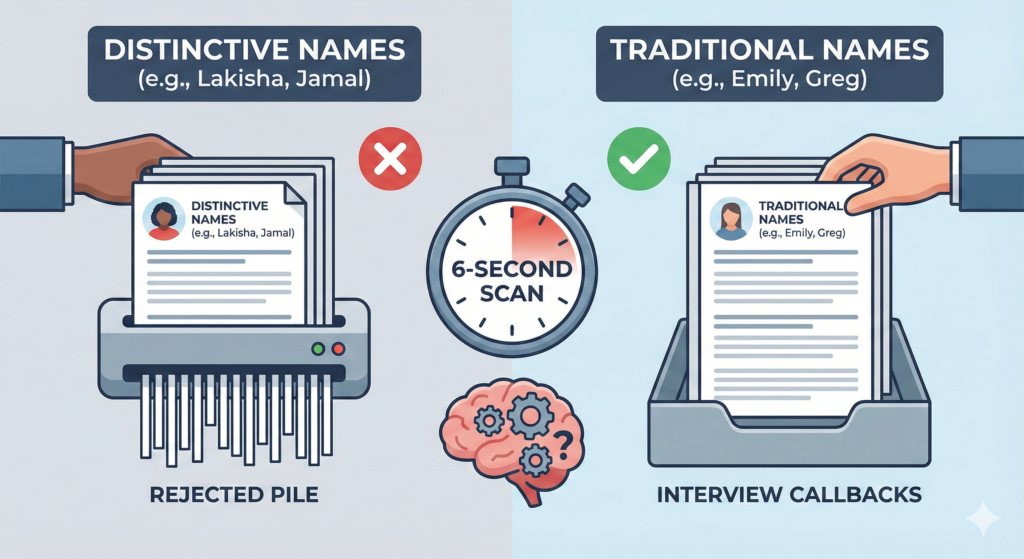
This is name bias at work. It is subtle, widespread, and often invisible. Recruiters, sometimes without realizing it, lean toward certain names and hesitate over others. Names are not just labels. They act as signals, and those signals can quietly shape hiring decisions.
Let’s look at what the data actually shows, why this happens psychologically, and what is being done to make hiring fairer.
(Quick thing: If you have ever wondered how rare or common your own name is, you can check the real statistics using our Name Frequency and Uniqueness Tool on the homepage.)
The Hard Evidence: Yes, It Is Real
For a long time, name bias was brushed off as a feeling rather than a fact. Many people experienced it, but proving it was difficult. That changed once researchers started testing it directly.
The “Emily vs. Lakisha” Study
One of the most well known studies was published in 2003 by economists Marianne Bertrand and Sendhil Mullainathan through the National Bureau of Economic Research.
The researchers sent out nearly 5,000 fake resumes to job ads in Boston and Chicago newspapers. Every resume was identical in education, skills, and experience. The only thing that changed was the name.
Half of the resumes used names like Emily Walsh or Greg Baker, which were commonly perceived as White sounding. The other half used names like Lakisha Washington or Jamal Jones, which signaled African American identity.
The results were stark.
Resumes with White sounding names received about 50 percent more callbacks. A highly qualified candidate with the name Lakisha received fewer responses than a less qualified applicant named Emily.
This study provided clear evidence that a name alone can limit opportunities, even when qualifications are strong.
Still Stuck in the Same Place
It would be reasonable to assume that awareness would reduce this problem over time. However, newer research suggests otherwise.
More recent studies show similar patterns across different countries. In Canada, applicants with Asian sounding names received significantly fewer callbacks despite having comparable education and work histories. Similar results have appeared in studies conducted in the United Kingdom, France, and Germany.
Despite changes in hiring technology and increased conversations about diversity, name based bias continues to influence decisions.
Why This Happens: The Psychology Behind It
It is tempting to assume that all biased hiring decisions are intentional. In reality, much of this happens unconsciously.
The Six Second Glance
Recruiters are often overwhelmed with applications. Research shows they may spend only six or seven seconds reviewing a resume before making an initial judgment.
In these moments, the brain looks for shortcuts. It relies on familiarity, past experiences, and cultural cues.
A name like John Smith feels familiar and safe. It fits expectations. A name that feels unfamiliar or associated with a minority group can trigger hesitation, even if only for a moment. That brief pause can be enough for a resume to be overlooked.
This does not always come from malice. It often comes from mental shortcuts, but the result is the same. Qualified candidates miss out on opportunities.
It’s Not Just About Race
While racial and ethnic bias receives the most attention, names can activate other forms of bias as well.
Gender Bias
Gendered names can influence hiring decisions, especially in male dominated fields like science and engineering. In one well known study, science faculty evaluated identical applications for a lab manager position. The only difference was the name.
Applicants named John were rated as more competent and more hireable than those named Jennifer, despite having identical resumes.
Generational and Class Bias
Names also signal age and perceived background. Some names are strongly associated with certain generations or social classes. When recruiters see those signals, they may make assumptions about experience, adaptability, or cultural fit, even without realizing it.
The Bigger Picture
Name bias shows how deeply first impressions shape professional opportunities. Even before skills, education, or experience are considered, a name can quietly influence how a resume is judged.
Understanding this reality is not about discouragement. It is about awareness. Recognizing how names affect perception is one of the first steps toward building fairer hiring systems and giving talent the attention it deserves.