
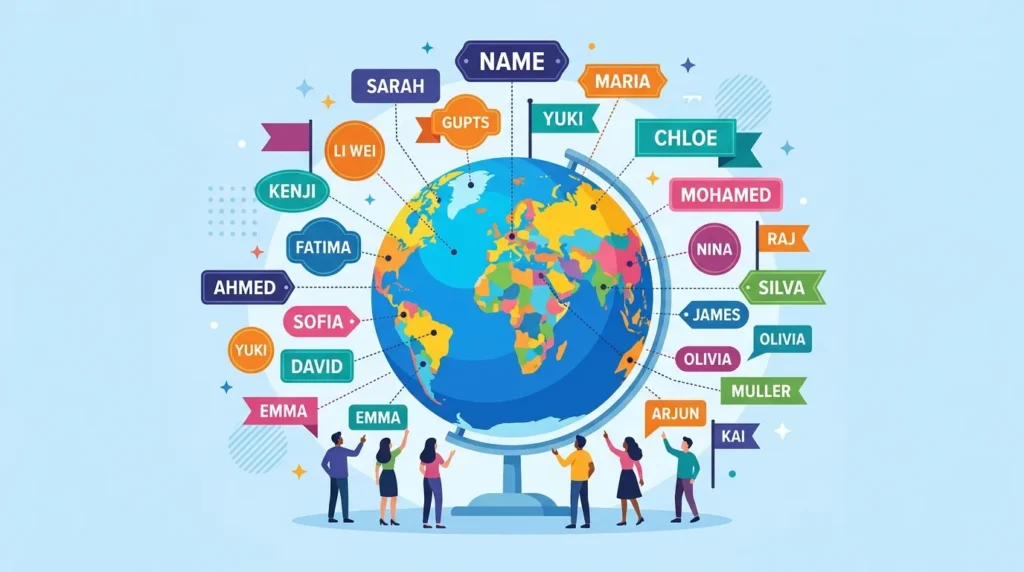
There is no single definitive count of how many names exist in the world. The honest answer is that the number runs into the millions and keeps growing every year. But we can get much closer to a real answer than most people expect by looking at the data that does exist across different countries, languages, and naming systems.
This article breaks down the best available statistics from government records, academic databases, and global name registries to give you a concrete picture of how many names humans have created, how many are still in active use, and why the total keeps changing.
How Many First Names Exist?
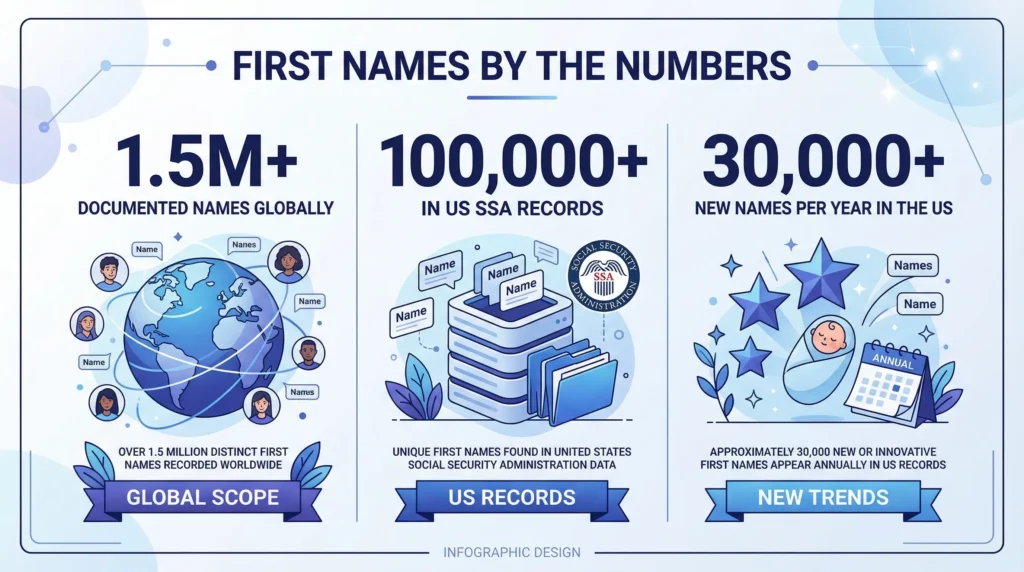
The short answer: at least 1.5 million documented first names across 139 countries, based on the Name Census database. But that number only includes names that appear in official government records and verified social media profiles. The true count is almost certainly higher.
Here is what we know from the best available sources:
The Name Census database, one of the most comprehensive name databases in the world, contains 1,507,690 validated first names collected from 139 countries. Of those, 806,637 are categorized as male names and 701,053 as female names. This data was compiled from government agencies, statistical bureaus, and over 22 million social media profiles used for cross-referencing.
In the United States alone, the Social Security Administration has recorded over 100,000 distinct given names in its birth records going back to 1880. Every year, more than 30,000 different names appear in new US birth registrations. That number climbed steadily until 2008 and has dipped slightly since then, but the overall trend over the past century is toward more name diversity, not less.
In the United Kingdom, the Office for National Statistics tracks baby names annually and typically records between 25,000 and 35,000 unique names each year.
When you account for all languages, all writing systems, all historical periods, and all the spelling variations that exist across cultures, estimates from linguists and onomastics researchers suggest the global total of distinct given names falls somewhere between 5 million and 10 million. Some estimates go even higher when every transliteration and regional spelling is counted as a separate name.
How Many Last Names Exist?
Surnames are even more numerous than first names. The Name Census database contains 3,251,185 surnames from 139 countries. The Forebears global name database, which covers 236 jurisdictions, contains over 27 million surname records as of its most recent update.
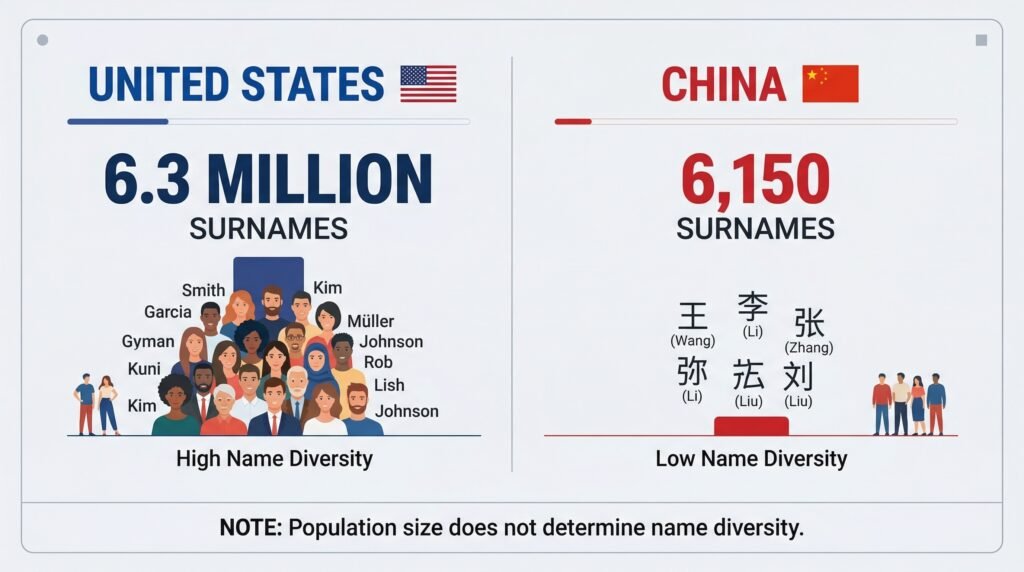
In the United States, the 2010 Census recorded approximately 6.3 million distinct surnames. That is a remarkably high number for a country of 330 million people, and it reflects the diversity of immigration patterns that have shaped the American population over centuries.
China offers an interesting contrast. Despite having the largest population on Earth at 1.4 billion people, China had only about 6,150 surnames in active use as of 2018, according to a report from the Ministry of Public Security. The top five Chinese surnames (Wang, Li, Zhang, Liu, and Chen) account for roughly 30.8% of the entire population. Wang alone is shared by approximately 101.5 million people.
This contrast highlights an important point: the number of names in use in a country depends on its cultural history, not its population size. Countries with strong patronymic traditions, diverse immigration, or languages that allow flexible name creation tend to have much larger name pools.
The Most Common Names on Earth
Some names are shared by tens of millions or even hundreds of millions of people worldwide. Here are the most widely held names on the planet, based on available data:
Most Common First Name
Muhammad (and its many spelling variations including Mohammad, Mohammed, Mohamed, and Mehmet) is widely considered the most common given name in the world. Estimates suggest that more than 150 million people globally carry some version of this name, spanning dozens of countries across the Middle East, South Asia, Southeast Asia, and Africa.
Most Common Surnames
The most common surnames in the world are dominated by Chinese family names due to China’s enormous population and relatively small surname pool:
Wang: approximately 101.5 million people in China alone, with millions more globally. The name translates to “king.”
Li / Lee: over 100 million people across Chinese, Korean, and Vietnamese heritage. The name derives from the Chinese word for “plum tree.”
Zhang: over 95 million people of Chinese origin. The name relates to the invention of the bow and arrow.
Outside of East Asia, other extremely common surnames include Nguyen (shared by approximately 40% of the Vietnamese population), Garcia and Gonzalez (each held by over 10 million people of Spanish and Latin American origin), Smith (roughly 2.3 million bearers in the United States alone), and Mohammed as a surname across many Muslim-majority countries.
You can look up how many people share any specific name in the United States using our name statistics tool. For global surname data, Forebears.io provides distribution maps across 236 countries and territories.
Why the Number of Names Keeps Growing
The total number of names in the world is not static. It increases every single year for several reasons.
Invented names
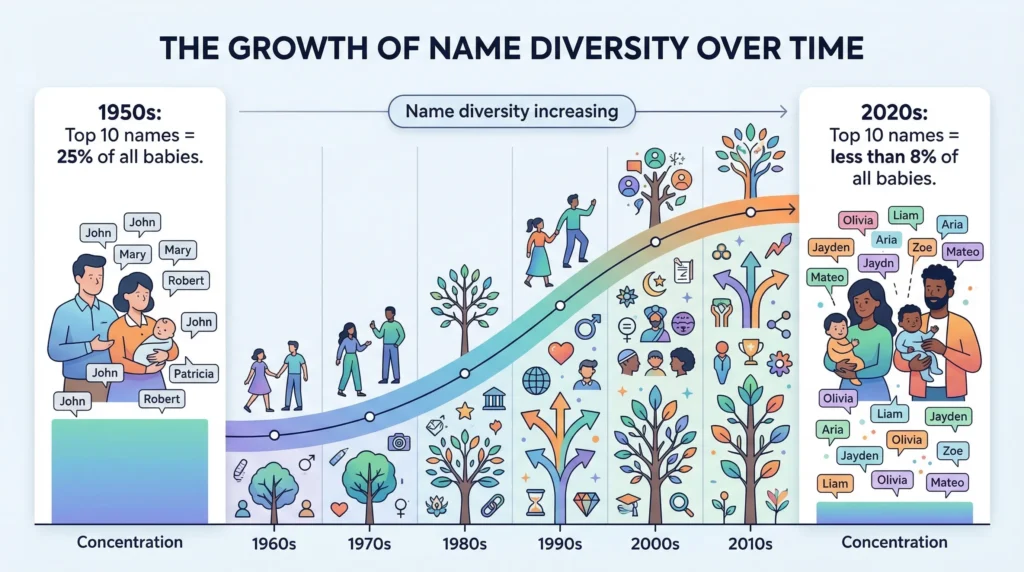
Parents increasingly create entirely new names for their children. In the United States, the SSA data shows a clear trend toward greater name diversity over time. The share of babies receiving a top-10 name has dropped from over 25% in the 1950s to under 8% today. That means parents are choosing from a much wider pool and, in many cases, creating names that have never appeared in the records before.
Spelling variations
A single phonetic name can exist in dozens of different spellings. Catherine, Katherine, Kathryn, Cathryn, Katharine, and Catheryn are all treated as separate names in official records. Every new variation adds to the total count. Our name rarity checker shows how different spellings can have dramatically different bearer counts.
Cross-cultural borrowing
Globalization has accelerated the spread of names across language boundaries. Japanese names appear in American birth records. Arabic names are registered in European countries. Indian names show up in Australian data. Each cross-cultural adoption introduces names into record systems where they were previously absent.
Cultural and media influence
Popular culture drives naming trends. The SSA records show measurable spikes in names like Arya and Khaleesi after Game of Thrones aired, and an increase in Katniss following The Hunger Games. These names may have existed before, but their sudden widespread adoption effectively adds them to the active name pool in countries where they were previously unknown. Our article on how cultural moments affect name popularity explores this pattern in depth.
How Many Names Are There by Country?
Name counts vary enormously from country to country. Here are some of the most notable examples:
United States: Over 100,000 unique first names in SSA records spanning 1880 to present. Approximately 6.3 million unique surnames recorded in the 2010 Census.
China: Approximately 6,150 surnames in active use (2018 data). Given name combinations are far more numerous because Chinese given names are typically composed of one or two characters selected from thousands of possibilities.
United Kingdom: Between 25,000 and 35,000 unique baby names registered annually.
India: India has one of the most diverse naming systems in the world, with names drawn from dozens of languages including Hindi, Tamil, Bengali, Telugu, Marathi, and many others. No comprehensive national count exists, but the diversity is estimated to rival or exceed that of the United States.
Iceland: One of the most restrictive naming systems. The Icelandic Naming Committee maintains an approved list of roughly 1,800 male names and 1,800 female names. Names not on the list require special approval.
Japan: Japanese names draw from thousands of kanji characters, but the government restricts which characters can be used in names. Despite this, the combination possibilities create enormous diversity.
The difference between Iceland’s roughly 3,600 approved names and the millions of names circulating globally illustrates just how much naming practices vary across cultures. For a deeper look at how common or rare any specific name is in the United States, try searching it in our How Many of Me tool.
Names That Are Disappearing
While the total number of names grows, many individual names are fading from use. In the United States, thousands of names that were common a century ago now have fewer than 100 living bearers. Names like Mildred, Gertrude, Clarence, and Elmer were given to tens of thousands of babies in the early 1900s but barely register in modern birth records.
Surnames can disappear too. When a family line ends or when all members of a family change their name, a surname can go extinct entirely. Our article on rare last names you have probably never heard of profiles some of the rarest surnames still in existence in the United States.
The How Many of Me tool uses age-adjusted survival modeling to estimate how many people with a given name are likely still alive today. A name that was popular in the 1920s but fell out of use will show a much lower count than its historical registration numbers suggest, because the vast majority of people born in that era have since passed away.
At the same time, some of these “extinct” names are making comebacks. Names like Clara, Ezra, Walter, and Theodore all dropped sharply after their peak decades but have returned to popularity as parents seek names that feel vintage rather than outdated. Our 2025 baby name trends article tracks which names are rising and falling right now.
So How Many Names Are There? The Final Count
Pulling together the best available data, here is the most honest answer we can give:
Documented first names worldwide: At least 1.5 million, and likely between 5 and 10 million when all languages, historical records, and spelling variations are included.
Documented surnames worldwide: Over 27 million recorded in the Forebears database across 236 jurisdictions. The US alone has 6.3 million.
Combined total of all unique name forms globally: Plausible estimates range from 50 million to over 500 million when every spelling variation, transliteration, compound name, and regional variant is counted separately.
New names added every year: Tens of thousands, driven by invented names, cross-cultural adoption, and spelling creativity.
The honest conclusion is that nobody knows the exact number, and the number itself changes every day. What we do know is that naming is one of the most universal and diverse human practices. Every culture on Earth names its children, and every culture does it differently.
If you want to see where your own name falls in this enormous landscape, our name statistics tool lets you check how many people in the United States share any first name or last name, with full breakdowns by gender, age, state, and decade. For name meanings and origins, browse the name meaning directory.
Frequently Asked Questions
How many first names are there in the world?
At least 1.5 million documented first names exist across 139 countries based on the Name Census database. When all languages, historical periods, and spelling variations are included, the real number is likely between 5 and 10 million.
How many last names are there in the world?
The Forebears global database records over 27 million surname entries across 236 jurisdictions. In the United States alone, the 2010 Census counted approximately 6.3 million distinct surnames.
What is the most common name in the world?
Muhammad (including spelling variations) is widely considered the most common given name globally, with over 150 million bearers. The most common surname is Wang, shared by approximately 101.5 million people in China alone.
How many new names are created each year?
In the United States alone, over 30,000 distinct names appear in birth registrations each year. Globally, the number is much higher as parents across all countries create new names and adopt names from other cultures.
Are names disappearing?
Yes. Thousands of names that were common a century ago now have very few living bearers. However, some of these names are experiencing revivals as parents seek vintage-sounding names for their children.
How can I find out how many people share my name?
Use the How Many of Me tool to instantly check how many people in the United States share any first name or last name. The tool provides a full breakdown by gender, age group, state, and decade.
Sources:
- Social Security Administration National Baby Names Dataset
- Name Census Global Database
- Forebears Global Name Distribution
- US Census Bureau Surname Data
- China Ministry of Public Security 2018 Name Report
- SSA Background Information on Popular Names